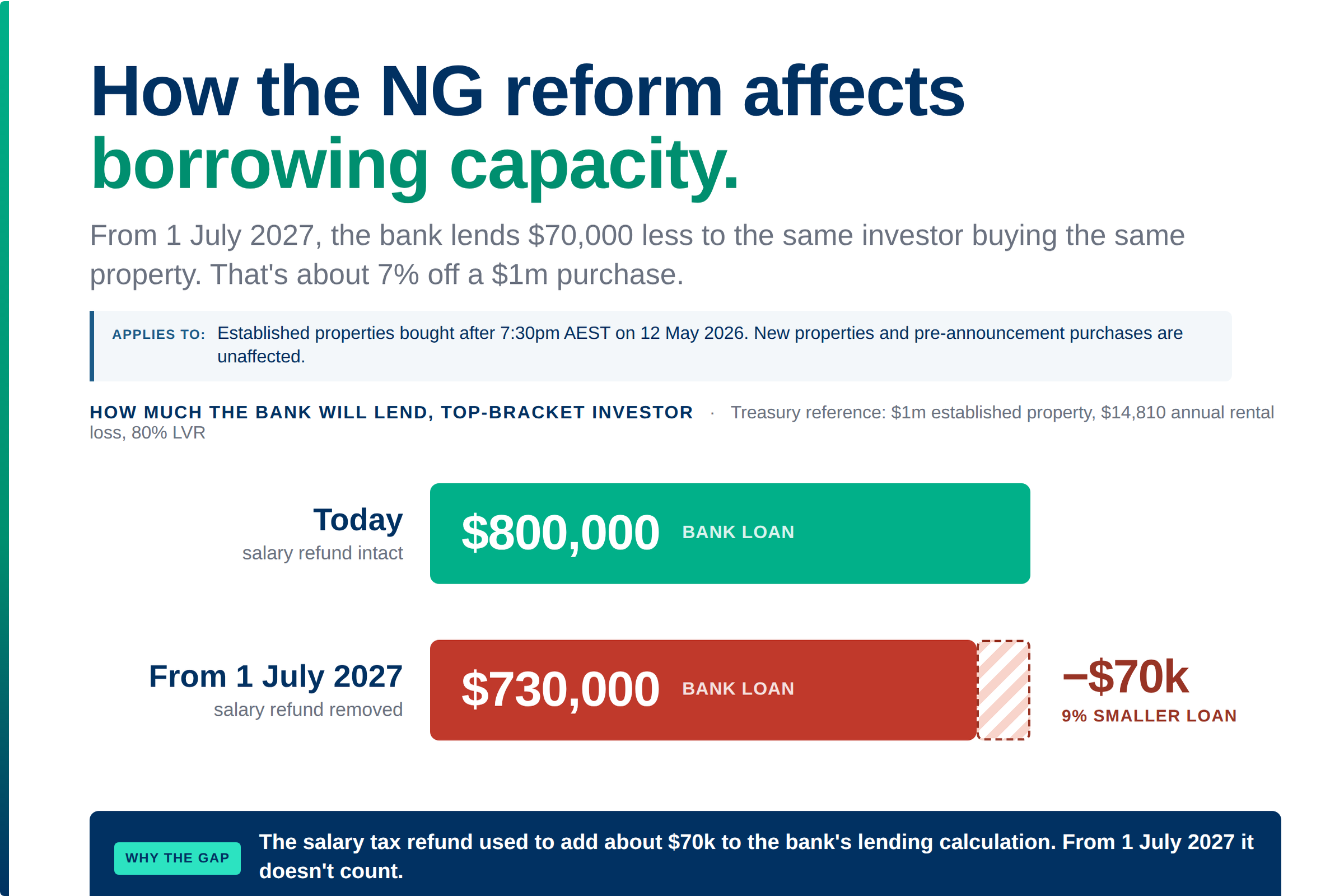
For a top-bracket investor buying a $1m established property after 12 May 2026, the new rules mean about $70,000 less the bank will lend, or 7% off the purchase budget.
Key takeaways
- Two dates govern the change. Established properties bought after 7:30pm AEST on 12 May 2026 are affected by the reform. The new tax treatment applies to all of them from 1 July 2027.
- Scope: the changes apply only to established properties purchased after the announcement. New properties, properties bought before the announcement, and properties where the rent more than covers the loan are unaffected.
- Mechanism: from 1 July 2027, the rental loss on an affected property can only be used to reduce income from other residential properties (including capital gains), not income from salary and wages.
- Treasury’s worked example: on a $1 million established property at a 3.1% rental yield and a 5.7% interest rate, Treasury puts the annual rental loss at $14,810.
- The borrowing capacity hit at that example: for an investor on the top tax bracket, losing the tax refund worth $6,961 a year translates to roughly $70,000 less the bank will lend. That is about 7% off a $1 million purchase price.
- How the hit scales: the impact ranges from around 3% of borrowing capacity (small loss, lower bracket) to around 33% (large loss, top bracket).
- Carried forward, not lost: the rental loss carries forward to future years and remains available to offset rental income or capital gains on sale.
The 2026-27 Federal Budget has changed how negative gearing works for established properties bought after the announcement. The change is presented as a tax reform, and it is one. But it also changes something less obvious: how much the bank will lend an investor to buy in the first place. The tax refund that used to lower an investor’s annual tax bill also used to make the loan application bigger. Take it away, and both shrink together.
To see why, three things need to be on the table.
What negative gearing actually is
Negative gearing is the arrangement where the costs of holding an investment property (mortgage interest, plus rates, insurance, agent fees, maintenance) come to more than the rent it earns. The shortfall is a rental loss. Under the current rules, an investor can subtract that loss from their other taxable income, including salary and wages, and pay tax on the smaller amount. The lower tax bill comes back as a refund.
What the Budget changed
The Budget introduces two dates that determine which properties are affected. The first is 7:30pm AEST on 12 May 2026, the announcement date. The second is 1 July 2027, when the new tax treatment begins.
The new rules apply only to established properties bought after the announcement. Properties bought before the announcement are protected. They keep the existing rules indefinitely, until they’re sold. New properties are unaffected entirely.
For established properties bought after 12 May 2026, there is a temporary window. Between the announcement and 30 June 2027, the existing rules still apply, so a buyer in this window can negatively gear against salary in the same way as before. From 1 July 2027 onwards, those same properties shift to the new rules, along with any established property bought from 1 July 2027 onwards. The window does not exempt the property from the new rules. It just delays them.
Under the new rules, the rental loss can still be deducted, but only against income from other residential properties (including capital gains on sale). It can no longer be deducted against salary or wages. The loss itself is not extinguished: any excess carries forward to future years and remains available against future rental income or capital gains on sale.
Why the tax refund matters to the bank
This is where the tax change becomes a borrowing change. Banks count an investor’s expected tax refund as part of their serviceable income, the income figure they use to calculate borrowing capacity (how much the bank will lend). Every extra dollar of taxable income translates to about $10 of additional borrowing capacity over a 30-year loan term at today’s APRA-buffered assessment rates (the current interest rate plus the 3 percentage point buffer that APRA, the banking regulator, requires lenders to add when testing a borrower’s serviceability). At present, that buffered rate sits at around 9.25%.
When the refund disappears, that slice of borrowing capacity disappears with it.
A worked example, in stages
The cleanest starting point is the example Treasury publishes in its Budget guidance. Treasury anchors its numbers on a $1 million established property at a 3.1% gross rental yield and a 5.7% interest rate, with an 80% loan-to-value ratio. On those inputs, Treasury puts the annual rental loss at $14,810.
The $14,810 figure is the gap between two numbers: the $45,600 of mortgage interest on the $800,000 loan, less the $31,000 of annual rent. Treasury keeps the example clean by excluding the smaller holding costs (rates, insurance, agent fees, maintenance) that a real investor would also deduct. In practice, a real investor’s loss would tend to be larger.

Here is how the maths runs for an investor on the top tax bracket. Australian residents earning over $190,000 pay a 45% top marginal tax rate, plus the 2% Medicare levy (the flat 2% of taxable income that funds the public health system), for a combined 47% on each extra dollar.
Step 1. The annual loss. Treasury’s worked example puts the rental loss on the property at $14,810 a year.
Step 2. The tax refund under current rules. Today, that $14,810 loss reduces the investor’s taxable income from salary by $14,810. At a 47% marginal rate, the tax refund is:
Step 3. How banks read that refund. Banks treat the projected refund as if it were extra annual income, because the investor sees it as cash in hand every year. The $6,961 refund becomes $6,961 of additional serviceable income.
Step 4. From extra income to extra borrowing. At the current 9.25% buffered assessment rate over a 30-year loan term, each $1 of extra annual income supports about $10 of additional borrowing capacity. Running $6,961 through that:
Step 5. What changes from 1 July 2027. For a property bought after 12 May 2026, the $14,810 loss can no longer be applied against salary from 1 July 2027 onwards. The $6,961 refund against salary disappears. Banks have nothing extra to count. The $70,000 of borrowing capacity goes with it.
The net effect: for the same investor buying the same property, about $70,000 less the bank will lend, or roughly 7% off a $1 million purchase price.
The same arithmetic runs the other way at lower tax brackets. The loss is the same $14,810; what changes is the rate applied to it, and therefore the refund.
Treasury cites the $4,761 and $6,961 figures directly in its Budget guidance. The 39% row is interpolated for an investor in the middle bracket.
How the hit scales beyond Treasury’s example
Treasury notes that $14,810 is roughly the average annual negative gearing loss in 2022-23 for an investor on the top tax bracket. Many affected investors will sit near that average. Some will sit well above. A more leveraged position, a lower-yielding property, or both, can run a rental loss of $30,000, $50,000, or higher. The borrowing-capacity hit scales linearly with both the loss size and the tax bracket.

The smallest combination on the grid (a $10,000 loss at a 32% rate) takes about 3% off a $1 million purchase budget. The largest (a $70,000 loss at the top bracket) takes off more than a third. Treasury reports that around 1% of taxfilers, roughly 230,000 individuals in 2022-23, acquired a negatively geared property that year. Where any individual lands on this grid depends on how much they borrow, what they buy, and how they earn.
A real bank’s serviceability model will not produce these exact numbers. Lenders differ in the rates they apply, how they shade rental income (most discount it by 20-25% before counting it), the living-expense floors they impose, and how they treat investor versus owner-occupier loans. The figures above should be read as the order of magnitude of the hit, not a quote.
What this does and does not change
The changes are not a wholesale repeal of negative gearing. They apply only to established properties bought after 12 May 2026, taking effect from 1 July 2027. Properties bought before the announcement are protected indefinitely. New properties keep full negative gearing under the existing rules. Properties where the rent more than covers the costs are unaffected, because there is no rental loss in the first place.
Even on properties caught by the new rules, the rental loss is not lost. It carries forward to future years and remains available to offset rental income from other properties, or the capital gain when the property is eventually sold. The change shifts when an investor receives the tax benefit, not whether they receive it.
The bottom line
Treasury’s worked example puts the borrowing capacity hit at around $70,000 for an investor on the top tax bracket buying a $1 million established property under the new rules. That is 7% off the purchase budget for the same investor, the same property, the same lender, and a deduction Treasury values at $6,961 a year. The reform doesn’t remove negative gearing; it changes when and how the benefit can be claimed. But for any investor going to a bank to fund the next purchase, the connection between tax and borrowing is the part that lands.
Cut through the noise on Australian property
Subscribe for free.
Keep reading
- The RBA held the cash rate at 4.35%, a 12-year high. The borrowing-power squeeze is cooling the capitals from the top down, while the regions hold up better.

- Reset or Regime Change? What the Budget’s Tax Changes Mean for Property Prices

- How the 2026-27 Budget’s negative gearing reform affects your borrowing capacity
